You Won’t Believe What I Saw in the Serengeti—Culture Like Nowhere Else
The Serengeti isn’t just about wildebeest migrations or lions lazing in the sun. For me, the real magic was in the Maasai villages, where tradition pulses through every dance, beadwork, and story. This isn’t just a safari—it’s a living cultural journey. I never expected to feel so connected to a place just by watching how people live, pray, and celebrate under the same skies as the wildlife we all come to see. The rhythm of life here moves with the earth, not against it. There are no loud announcements, no staged shows for tourists—only quiet dignity, deep roots, and a way of being that feels both ancient and urgently relevant today.
The First Glimpse: Stepping Into a Living Culture
Arriving at a Maasai boma near the Ngorongoro Conservation Area felt less like entering a tourist site and more like stepping across an invisible threshold into another world. The air carried the scent of dried dung from the huts, mingling with woodsmoke and the faint sweetness of wild herbs. Women in vibrant red shukas moved between round mud-walled homes, their beaded necklaces catching the morning light. Children paused mid-laugh to watch us, not with fear but curiosity. A man stood at the entrance, staff in hand, his gaze steady. This was not a performance. It was life—unscripted, unfiltered, and deeply intentional.
What struck me most was the sense of presence. Everyone moved with purpose. There were no idle gestures, no wasted movements. Even the youngest child carried a stick to guide goats, mimicking the elders. Our guide, a Tanzanian naturalist who had worked with Maasai communities for over a decade, reminded us to walk slowly, speak softly, and wait to be invited into spaces. He explained that entering a boma is not like visiting a museum—it requires humility. You do not point, you do not touch without permission, and you never assume you are the center of attention.
Cultural viewing in this context is not passive observation. It is an exchange of energy, a silent acknowledgment of mutual respect. The Maasai do not perform for visitors unless they choose to. When they do share songs or dances, it is often in response to genuine interest and respectful behavior. That first hour in the boma taught me more about presence than any meditation retreat ever had. To truly see, I had to stop trying to capture. I had to simply be.
Eyes Wide Open: The Art of Watching Without Intruding
One of the most important lessons I learned was the difference between looking and seeing. Many travelers arrive with cameras ready, eager to photograph every moment. But real cultural observation requires restraint. Ethical engagement begins with understanding that these are not exhibits—they are people living full, complex lives. The Maasai have their own rhythms, their own reasons for doing things a certain way, and their own boundaries around what is shared with outsiders.
Voyeurism happens when we treat culture as entertainment. Meaningful engagement happens when we approach with questions, not assumptions. For instance, instead of asking, “Why do you dress like that?” a better question might be, “What does your clothing mean to you?” The first reduces culture to costume; the second invites connection. Our guide emphasized this repeatedly: ask with humility, listen with openness, and accept that some things may not be explained. Some knowledge is earned over time, not granted upon request.
Thankfully, many village visits in the Serengeti region are now structured to protect authenticity. Communities partner with tour operators who ensure fair compensation, limit group sizes, and allow the Maasai to control what is shown and how. In one village, we were told that photography was allowed only after a community meeting had approved it that morning. This kind of consent is rare in mass tourism but essential for dignity. When travelers understand that they are guests, not customers, the entire dynamic shifts. The experience becomes less about consumption and more about connection.
Rhythm of the Earth: Music, Dance, and Daily Rituals
One evening, as the sun dipped below the acacia trees, the men formed a circle. The adumu—the famous jumping dance—was about to begin. But our guide reminded us: this is not a show. For the Maasai, jumping is not entertainment; it is a rite of strength, a display of endurance, and sometimes, a prayer for rain or protection. The higher a man jumps, the more he honors his community. As the chanting rose and the jumps grew higher, I felt the ground vibrate beneath my feet. It wasn’t just sound—it was energy moving through the earth.
What surprised me most was how integrated music and movement are into daily life. Children practice jumping in the fields between chores. Women sing while grinding maize or walking long distances for water. These are not performances for tourists—they are expressions of identity, passed down through generations. Even the rhythm of walking, the way a herder calls to cattle with a low whistle, carries meaning. Every sound has a purpose, every movement a message.
The role of elders in preserving these traditions cannot be overstated. In one homestead, I sat with an elder who spoke softly through a translator. He told stories of droughts survived, lions driven away, and peace maintained between clans. His voice was calm, but his presence was commanding. Nearby, a group of children listened intently, repeating phrases under their breath. Tradition isn’t taught in classrooms here—it’s lived. It’s in the way a girl ties her shawl, the way a boy learns to track animals, the way a grandmother hums a lullaby that has been sung for centuries. These rituals are not relics. They are living threads in a continuous story.
Threads of Identity: Decoding Beadwork and Dress
If language is spoken, then Maasai beadwork is written. Every color, every pattern tells a story. Red stands for bravery and unity. Blue represents the sky and God’s protection. Green speaks of the land and prosperity. White symbolizes purity and peace. Black reflects the hardships endured and overcome. A necklace is not just jewelry—it is a biography. A woman’s age, marital status, and even her clan can be read in the beads she wears.
I spent an afternoon watching a group of women craft intricate collars using tiny glass beads and thin wire. Their fingers moved with precision, each bead placed with care. One woman explained that creating a single piece could take weeks. Yet there was no rush. The process itself was meditative, a form of storytelling. As they worked, they sang softly, their voices blending with the rustle of leaves. I noticed how proud they were to show their work—not for sale, but for understanding. They wanted us to see the meaning behind the beauty.
In a world where fast fashion dominates, the Maasai commitment to handmade tradition is quietly revolutionary. Their clothing is not chosen for trends but for meaning. Even younger generations, some of whom attend school or use smartphones, continue to wear traditional dress with pride. This is not resistance to change—it is balance. They adapt where necessary but hold fast to what defines them. To wear a red shuka is to say: I know who I am. And that quiet confidence is more powerful than any slogan.
Between the Wild and the Human: Coexistence in the Serengeti Landscape
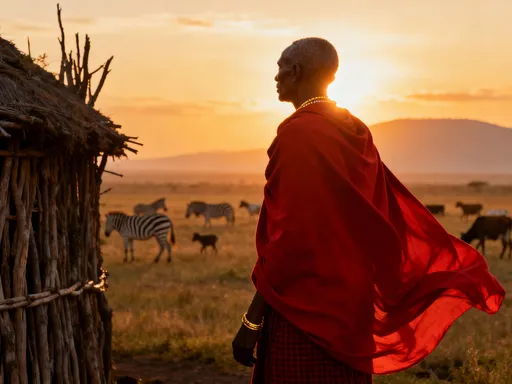
One morning, I climbed a low hill near a Maasai homestead. From that vantage point, I saw something extraordinary: a mixed herd of zebra and Maasai cattle grazing side by side, separated only by the occasional thorn fence. A group of warriors sat nearby, watching both the animals and the horizon. There were no electric fences, no loud noises to scare wildlife away. Instead, there was an unspoken understanding—space shared, not claimed.
This coexistence is not accidental. For centuries, the Maasai have lived alongside lions, elephants, and migratory herds. Their grazing patterns avoid sensitive areas. Their homes are built in ways that minimize disruption. When predators approach, they use traditional methods—fire, noise, coordinated movement—rather than lethal force. This knowledge, passed down through generations, is now being recognized by conservation scientists as vital to ecosystem balance.
Modern parks often rely on fences and strict boundaries. But the Maasai model offers a different vision—one where humans are not separate from nature but part of it. Their land-use practices allow wildlife to move freely while still supporting livestock. This approach is not perfect, and challenges like drought and land pressure are real. But the core principle—harmony over control—offers a lesson the world urgently needs. In the Serengeti, the line between wild and human is not a border. It is a bridge.
Beyond the Snapshot: Why Cultural Viewing Changes Travelers
Most tourists leave the Serengeti with stunning photos of sunsets and wildlife. But the images that stayed with me were quieter: a grandmother braiding her granddaughter’s hair, a young man teaching a child to jump, a woman offering me a cup of warm tea made from local herbs. These moments were not staged. They were offered freely, in the spirit of hospitality.
What changed me was not seeing these things—but allowing myself to feel them. Too often, travel is about collecting experiences like souvenirs. We rush from site to site, camera in hand, trying to capture everything. But true understanding comes from stillness. It comes from sitting long enough to notice how light falls on a beaded bracelet, how a song rises at dusk, how a community moves as one. When we slow down, we stop being observers and become participants in a deeper way.
I realized that my initial awe had shifted into something more meaningful: respect. Not just for the Maasai, but for the idea that different ways of living are not lesser—they are simply different. My worldview expanded. I began to question my own assumptions about progress, efficiency, and success. What if a life measured by connection, not consumption, is richer? What if silence is more powerful than noise? These are not tourist questions. They are human ones.
Choosing the Right Path: How to Experience This Responsibly
Not all cultural visits are created equal. Some operators treat villages as photo stops, paying little to communities and encouraging intrusive behavior. The key to ethical travel is choosing partners who prioritize fairness, consent, and long-term impact. The best tour companies work directly with Maasai councils, ensure fair wages for guides and hosts, and limit group sizes to reduce disruption.
Before booking, ask questions. Who owns the experience? Are Maasai people employed in decision-making roles? Do they receive a fair share of the income? Is photography allowed only with permission? Reputable operators will answer openly. Some even provide transparency reports or community testimonials. Others partner with conservation NGOs to ensure that tourism supports both cultural preservation and environmental protection.
Your presence can be a force for good—but only if it’s grounded in respect. That means dressing modestly, asking before taking photos, and listening more than speaking. It means understanding that you are a guest, not a customer. When done right, cultural viewing becomes a form of support. Every visit that honors dignity helps sustain tradition. Every traveler who leaves with empathy becomes an ambassador for a way of life that deserves to endure.
Conclusion
The Serengeti’s truest spectacle isn’t in the drama of the hunt or the dust of migrating herds—it’s in the eyes of a Maasai elder who’s watched both for a lifetime. To witness culture here is to see resilience, beauty, and balance written in motion. It is to understand that tradition is not frozen in time but alive, adapting, and deeply wise. The Maasai do not live in the past. They carry it forward, with pride and purpose.
When we slow down and truly watch, we don’t just travel. We understand. And that changes everything. We begin to see that progress does not always mean new buildings or faster technology. Sometimes, progress is a child learning an ancient song. Sometimes, it is a community thriving in harmony with nature. The Serengeti teaches us that the most powerful journeys are not measured in miles, but in moments of connection. And those moments—quiet, unscripted, real—are the ones we carry forever.